-
×
 Steven Pieper – Author Marketing Mastery Through Optimization 4
1 × $9.00
Steven Pieper – Author Marketing Mastery Through Optimization 4
1 × $9.00 -
×
 Astra Gallery – The Art of Generating AI Content
1 × $20.00
Astra Gallery – The Art of Generating AI Content
1 × $20.00 -
×
 Damien Belak – The Affiliate Escape Plan
1 × $54.00
Damien Belak – The Affiliate Escape Plan
1 × $54.00 -
×
 Katelyn Bourgoin – Painkiller
1 × $25.00
Katelyn Bourgoin – Painkiller
1 × $25.00 -
×
 Stratagem Trading – Unbalanced Birds
1 × $239.00
Stratagem Trading – Unbalanced Birds
1 × $239.00 -
×
 Simpler Options – Ultimate Options Trading Blueprint
1 × $19.00
Simpler Options – Ultimate Options Trading Blueprint
1 × $19.00 -
×
 Justin Brooke – Growth Operator Blueprint
1 × $33.00
Justin Brooke – Growth Operator Blueprint
1 × $33.00 -
×
 The Players Guide : Be a High Value Strategic Player who F**** the TOP 1% Women
1 × $17.00
The Players Guide : Be a High Value Strategic Player who F**** the TOP 1% Women
1 × $17.00 -
×
 Talmadge Harper – Human Lie Detector
1 × $15.00
Talmadge Harper – Human Lie Detector
1 × $15.00


-80%
Buy With Coupon: DLC25 (-25%)
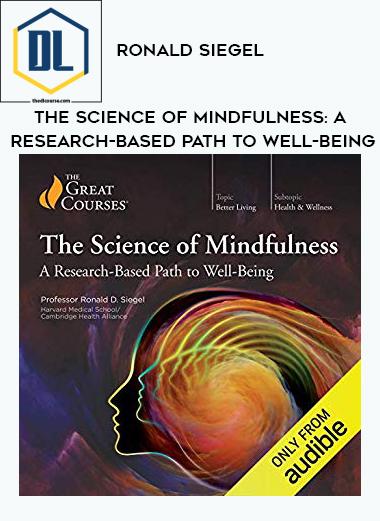
Ronald Siegel – The Science of Mindfulness: A Research-Based Path to Well-Being
Original price was: $234.95.$47.00Current price is: $47.00.
Description
Ronald Siegel – The Science of Mindfulness: A Research-Based Path to Well-Being
Description of The Science of Mindfulness: A Research-Based Path to Well-Being
A surprising number of such difficulties stem from an inherited propensity of the human brain—our automatic, hardwired tendency to seek pleasure and to anticipate and avoid pain. Modern science demonstrates that this mental hardwiring, traceable to the survival needs of our earliest ancestors, is at the root of many of the psychological and behavioral problems that we face today.
For thousands of years, people have used mindfulness practices—techniques to develop awareness of present experience with acceptance—to deal effectively with a wide range of life challenges. And, a large and fascinating body of scientific research now validates the remarkable benefits of mindfulness practice for psychological as well as physical health.
But how exactly does mindfulness work, in scientific terms? How can understanding the science and practice of mindfulness improve everyday life? And how can the human brain, whose very functioning gives rise to so many of the problems we struggle with, actually provide a solution?
Now, in the 24 fascinating lectures of The Science of Mindfulness, Professor Ronald D. Siegel, a clinical psychologist on the faculty of Harvard Medical School, reveals the science behind mindfulness in compelling detail and demonstrates its application to an extraordinary range of human problems—psychological, social, and medical. You’ll closely examine the neurobiology involved, leaving you with a clear knowledge of the science underlying ancient practices that are now profoundly influencing the contemporary world. And you’ll learn many practical ways you can use mindfulness techniques in your own life.
An Empirical “Inner Science”
We are now in the midst of an explosion of scientific research demonstrating that mindfulness practice changes both the function and the structure of the brain. Numerous studies, using such technologies as EEG and MRI, show which parts of the brain are affected by mindfulness practice, and how these neurobiological changes benefit our minds and bodies.
You’ll learn the science underlying mindfulness in topics such as:
Neurobiology and well-being: Learn how, when we’re worried or scanning the environment for trouble, our brain activity tends to center on the amygdala and the right prefrontal cortex, whereas left prefrontal cortical activity correlates with happiness, engagement, and contentment. Examine research demonstrating that sustained mindfulness practice activates this left prefrontal region.
Changing brain function and structure: Take a broad look at what neuroimaging technologies tell us about how mindfulness affects brain function by activating specific areas of the brain that regulate emotions, integrate feeling states and thought processes, deepen empathy and equanimity, and reduce cognitive decline as we age.
The science of self-preoccupation: Learn about the human brain’s “default mode network,” a neural system that’s activated during stressful thinking about ourselves, centered in the posterior cingulate cortex (PCC). Grasp how mindfulness techniques dramatically affect the PCC, quieting this hub of self-referential thinking.
A Stunning Range of Applications
One result of these scientific findings is that mindfulness practices have been adopted into mainstream psychotherapy and many other healthcare settings, showing effectiveness for a stunning range of conditions. You’ll explore how mindfulness practices are used to treat a wide variety of psychological and behavioral difficulties that can interfere with leading a rich and fulfilling life, such as
- Depression: Grasp how mindful awareness impacts depression by changing our relationship to moods, feelings, and thoughts, allowing us to perceive them as transient and ultimately impersonal events.
- Compulsive and addictive behaviors: Learn how mindfulness techniques can dismantle troublesome habits and behaviors by enabling us to “surf” waves of feelings and urges without having to act on them.
- Chronic pain: Discover the success of mindfulness practices in treating pain, by changing our relationship to moment-to-moment sensations and our thoughts about them.
- Stress and other psychological symptoms: Explore the extraordinary results of mindfulness techniques in groundbreaking stress-reduction programs, cognitive therapy, dialectical behavior therapy, and other acceptance-based treatments.
A Useful and Convenient Guide for Practice
While this course delves deeply into the neuroscience behind mindfulness, research shows that, like physical fitness, the benefits of mindfulness come from practicing it. With this in mind, Professor Siegel also teaches you a wide array of mindfulness techniques, encouraging and helping you to practice both with him, and on your own. These techniques, several of which are also provided, for enhanced practice, on supplementary audio tracks with the course, include:
- Breath Awareness Practice a foundational formal meditation practice and one of the simplest ways to calm and integrate the mind and body
- Loving-Kindness Practice a fundamental practice for cultivating acceptance, both toward the contents of your own mind and toward others;
- Mountain Meditation a core equanimity practice, valuable for riding out storms of emotion more effectively;
- Breathing Together a powerful practice for developing interpersonal connection;
- 3-Minute Breathing Space a practice useful in moments of acute distress;
- R-A-I-N a practice empowering you to be with and investigate challenging emotional or physical states; and
- Befriending the Changes a meditation on the impermanence of the body, useful for working with the challenges of illness and aging
As Professor Siegel makes clear in these lectures, mindfulness practice trains us to bring deep awareness to the present moment—to become more fully conscious of our unfolding sensory and mental experience as it arises. This mindful awareness, as research clearly shows, can profoundly change our relationship to all of our experience. And with more than three decades of success teaching mindfulness practices and exploring their scientific underpinnings with students, clients, and mental health professionals, Professor Siegel is an ideal guide.
Teaching of Uncommon Thoroughness and Depth
With a penetrating knowledge of both ancient mindfulness traditions and their modern uses, Professor Siegel reveals the striking intersections between traditional Buddhist psychology and Western cognitive science, showing how mindfulness practices can allow you to perceive the fluid nature of the “self” and the reality of your own profound interconnectedness with the world.
This playful, caring, and brilliantly designed course places in full view the impact and relevance of mindfulness techniques in responding effectively to many of humanity’s most fundamental psychological and existential problems. Revolutionary in its implications, The Science of Mindfulness shows you how these techniques can radically transform the mind, the heart, and the experience of everyday life—joining ancient wisdom practices and scientific methodology in forging new possibilities for living.
Readmore about: Ronald Siegel
Delivery Policy
When will I receive my course?
You will receive a link to download your course immediately or within 1 to 21 days. It depends on the product you buy, so please read the short description of the product carefully before making a purchase.
How is my course delivered?
We share courses through Google Drive, so once your order is complete, you'll receive an invitation to view the course in your email.
To avoid any delay in delivery, please provide a Google mail and enter your email address correctly in the Checkout Page.
In case you submit a wrong email address, please contact us to resend the course to the correct email.
How do I check status of my order?
Please log in to TheDLCourse account then go to Order Page. You will find all your orders includes number, date, status and total price.
If the status is Processing: Your course is being uploaded. Please be patient and wait for us to complete your order. If your order has multiple courses and one of them has not been updated with the download link, the status of the order is also Processing.
If the status is Completed: Your course is ready for immediate download. Click "VIEW" to view details and download the course.
Where can I find my course?
Once your order is complete, a link to download the course will automatically be sent to your email.
You can also get the download link by logging into your TheDLCourse account then going to Downloads Page.
Related products
-72%

Original price was: $54.00.$15.00Current price is: $15.00.
-98%
Original price was: $497.00.$9.00Current price is: $9.00.
-96%

Original price was: $497.00.$19.00Current price is: $19.00.
-97%
Original price was: $297.00.$9.00Current price is: $9.00.
-83%
Original price was: $265.00.$45.00Current price is: $45.00.
-70%
Original price was: $49.97.$15.00Current price is: $15.00.
-23%
Original price was: $29.90.$23.00Current price is: $23.00.
-95%

Original price was: $997.00.$47.00Current price is: $47.00.